Rothband Originals
Written & checked in-house
Compliance Corner
IRR17 vs IRMER: What’s the difference — and why your department answers to both
Two regulations, two different jobs. One protects staff, the other protects patients. Confusing them is where audit findings start.
RTBy the Rothband Team15 October 20266 min read

Protection screens in service. Photograph: Rothband.
Two regulations govern almost everything an imaging department does with ionising radiation — and they are routinely confused, even by experienced staff. IRR17 and IRMER sound alike, came into force in the same year, and overlap in the same rooms. But they have different jobs, different duty holders and different regulators. Getting them straight is the simplest way to avoid the most common audit findings.
One sentence each
IRR17 — the Ionising Radiations Regulations 2017 — protects staff and the public. It is workplace safety law, enforced by the Health and Safety Executive (HSE).
IRMER — the Ionising Radiation (Medical Exposure) Regulations 2017 — protects patients (and carers, comforters and research participants). In England it is enforced by the Care Quality Commission (CQC).
If a question starts with “what dose did our radiographer get?” you are in IRR17 territory. If it starts with “was this patient’s exposure justified?” that is IRMER.
Side by side
| IRR17 | IRMER |
|---|
| Protects | Employees, trainees and the public | Patients and others undergoing medical exposure |
| Enforced by | HSE | CQC (England) |
| Key expert | Radiation Protection Adviser (RPA) | Medical Physics Expert (MPE) |
| Local lead | Radiation Protection Supervisor (RPS) | Entitled duty holders in each role |
| Core question | Is occupational exposure as low as reasonably practicable, and within dose limits? | Is each exposure justified, optimised and carried out under a proper framework? |
| Dose limits? | Yes — legal limits, e.g. 20 mSv effective dose per calendar year for employees aged 18+ | No patient dose limits — justification and optimisation instead, supported by diagnostic reference levels |
The duty holders are different too
Under IRR17, every employer engaged in work with ionising radiation must consult a suitable Radiation Protection Adviser on observance of the regulations, and appoint one in writing where required. The RPS then supervises compliance with local rules day to day.
IRMER specifies four types of duty holder: the employer, the referrer, the practitioner and the operator. The practitioner is responsible for justifying each medical exposure; the operator is responsible for each practical aspect they carry out; the referrer must supply enough medical data for justification to happen properly. One person can hold more than one role — a radiographer may justify as practitioner and then perform the exposure as operator — but the responsibilities stay distinct, and entitlement to act in each role must be recorded.
Where departments actually get caught out
- Treating PPE as an IRR17-only issue. Protective equipment has to be examined at suitable intervals under IRR17 — but if a damaged apron lets a repeat exposure happen, that becomes a patient-safety and IRMER problem as well.
- No written entitlement. IRMER findings frequently come down to paperwork: who is entitled, by whom, and to do what, not written down.
- Confusing the experts. Your RPA advises on workplace protection; your MPE advises on patient dose and optimisation. In many trusts the same medical physics service provides both — but they are separate appointments.
- Forgetting carers and comforters. IRMER covers people who knowingly support a patient during an exposure. They need a dose constraint and proper instruction, not just an apron handed to them at the door.
The bottom line
Your department does not choose between IRR17 and IRMER. You answer to both, every day, in the same examination. Keep two questions on the wall: Are our people protected? (IRR17) and Was that exposure justified and optimised for that patient? (IRMER). If the answer to both is documented, you are most of the way to a clean inspection under either regime.
This article is general information for imaging departments, not legal or radiation protection advice for a specific site. Always confirm local arrangements with your RPA and MPE. Rothband inspects and tests radiation protective equipment and can provide documented records to support your IRR17 compliance — talk to the team if your apron fleet is due a check.
Sources: The Ionising Radiations Regulations 2017 and The Ionising Radiation (Medical Exposure) Regulations 2017 (legislation.gov.uk); Department of Health & Social Care, Guidance for the implementation of the IR(ME)R Regulations 2017 (gov.uk); CQC, Ionising Radiation (Medical Exposure) Regulations (IR(ME)R) guidance.
“Are our people protected? Was that exposure justified? Answer both, in writing, and you are most of the way to a clean inspection.”
Filed under: Compliance, IRR17, IRMER
Practical Guides • Occupational Health
The 20 mSv question: protecting the lens of the eye in interventional work
The eye-lens dose limit fell from 150 to 20 mSv a year. Many interventional teams still dress as if it didn’t.
RTBy the Rothband Team15 October 20265 min read

Certified protective eyewear. Photograph: Rothband.
Of all the dose limits in radiation protection, one changed more dramatically than any other — and it protects an organ many teams still leave uncovered. Under IRR17, the limit on equivalent dose for the lens of the eye is 20 mSv in a calendar year (or, under HSE-approved conditions, 100 mSv over five consecutive years with no more than 50 mSv in a single year). The previous limit was 150 mSv a year. That is not a tweak. It is a seven-fold tightening, driven by evidence that the lens is more sensitive than once thought.
Why the lens, and why now?
The lens of the eye is unusually vulnerable because its cells are never shed — damage accumulates over a career. The clinical concern is radiation-associated lens opacities and cataract, seen in interventional work where staff spend long fluoroscopy sessions close to the patient, who is the main source of scatter radiation. Operators in interventional radiology and cardiology, and the scrub and anaesthetic colleagues who stand with them, carry the highest eye doses in the hospital.
Classification follows from the numbers: staff likely to receive more than 15 mSv a year to the lens of the eye are among those who must be designated as classified persons, with the dose assessment and health surveillance that status brings.
The uncomfortable gap in most departments
Walk into many interventional suites and you will see full apron and thyroid collar compliance — and patchy eyewear compliance. The reasons are familiar and human: glasses that fog, glasses that slip, glasses left in a locker because a list is running late, or a shared pair that fits nobody. None of those reasons reduce a dose record. Scatter does not check whether your eyewear was comfortable.
There is also a geometry problem. Most scatter reaches the operator from the patient, at an angle, often from the side when the operator turns toward a monitor. Eyewear that only shields from the front leaves that route open. Wrap-around designs and side shielding exist precisely because of how interventional work is actually done, not how it looks in a diagram.
A practical protection checklist
- Use the ceiling-suspended screen first. Eyewear is the last line of defence, not the first. Position the screen between the patient and your head for every run, and treat table curtains as standard, not optional.
- Wear certified eyewear for every case. Protective glasses should be certified to the same BS-EN 61331 family of standards as your aprons, with a stated lead equivalence. If the equivalence is not stated, do not assume it.
- Fit is protection. Gaps at the brow and cheek let scatter in. Eyewear should be fitted to the individual where possible, worn — not shared by default — and checked like any other PPE.
- Mind your head position. Turning away from the patient toward the monitor increases the angle of scatter to the lens and reduces the benefit of front-only shielding.
- Know your numbers. If your department issues eye or collar dosemeters, wear them as instructed, every time. A dosemeter in a locker protects no one and tells your RPA nothing.
- Inspect eyewear like aprons. Scratched, cracked or damaged lenses and frames belong in the same QC conversation as your apron fleet, with records kept alongside it.
The bottom line
The 20 mSv limit was not set to make life difficult. It was set because the evidence moved. Departments that protect the lens properly — screens first, fitted certified eyewear always, doses monitored honestly — are not just compliant. They are protecting the eyesight of the people the service cannot run without.
General information only — confirm dose assessments and classified-worker arrangements with your RPA. Rothband supplies certified protective eyewear and can advise on fitting for interventional teams.
Source: The Ionising Radiations Regulations 2017, Schedule 3 (Dose limits), legislation.gov.uk — checked October 2026.
“Scatter does not check whether your eyewear was comfortable.”
Filed under: Eyewear, Dose Limits, Interventional
Practical Guides • New
The 10-minute apron check: how to inspect a lead apron properly
The routine pass, what core damage feels like, and the log your next audit will ask for.
RTBy the Rothband Team15 October 20265 min read

A lightweight Rothband apron. Photograph: Rothband.
The most dangerous apron in your department is the one everyone assumes is fine. Protective cores crack from the inside — damage you will never see by looking at the cover. A proper inspection takes about ten minutes per garment, needs no special equipment for the routine pass, and produces the records your IRR17 audit asks for.
The routine pass (do this regularly)
- Lay it flat in bright light. Work over the whole front and back of the garment. Look for cover tears, abrasion, seam failure, loose stitching and stretched or damaged closures and straps. Check the label — garment ID, date of issue and Pb equivalence should still be legible.
- Feel the core. With flat palms, sweep the entire protective area slowly. You are checking for lumps, ridges, thin spots and any sign of cracking or bunching in the protective core. Pay extra attention to the fold and hang points, which is where fatigue shows first.
- Check the accessories. Run the same pass over thyroid collars, skirts and sleeves. Collars get crushed between garments on crowded rails; sleeves get caught in doors. They fail too.
- Log it. Garment ID, date, who checked it, pass or fail, and any action taken. This log is the part inspectors and auditors care about almost as much as the inspection itself.
What to do with a suspect garment
Tag it clearly, take it out of service immediately, and do not quietly put it back on the rail "until the proper check" — a failed-looking apron on a rail will be worn. Arrange an imaging check of the protective core (fluoroscopic or radiographic screening by a competent service) to confirm internal damage. Keep the record.
How often?
At suitable intervals under IRR17 — in practice, most UK departments run a formal inspection and imaging check annually, with six-monthly checks for high-use aprons in interventional suites. The routine visual-and-tactile pass can be built into ordinary housekeeping much more often. Your RPA sets the formal programme; what matters is that it exists, it is documented, and it happens.
General guidance — your RPA sets the inspection programme for your site. Rothband's scanning and inspection service provides documented records you can file straight into your compliance folder.
“A failed apron back on the rail looks like protection. It isn’t.”
Filed under: Apron Care, QC Testing, Compliance
Explainers • New
0.25, 0.35 or 0.5? Pb equivalence without the headache
What the numbers actually mean, where each belongs — and why heavier is not automatically safer.
RTBy the Rothband Team15 October 20265 min read
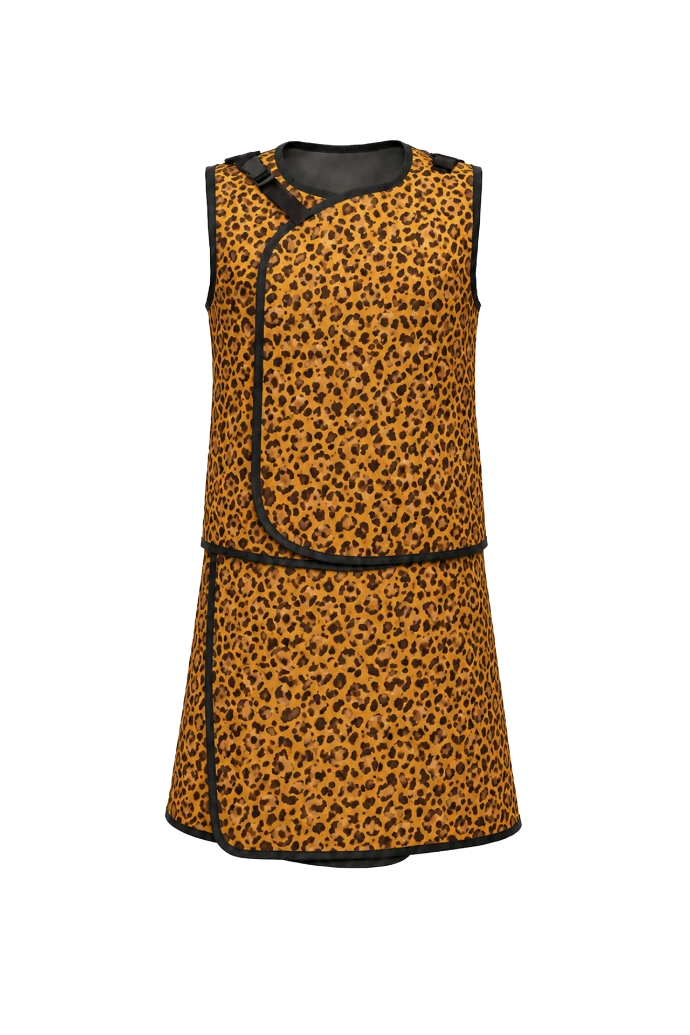
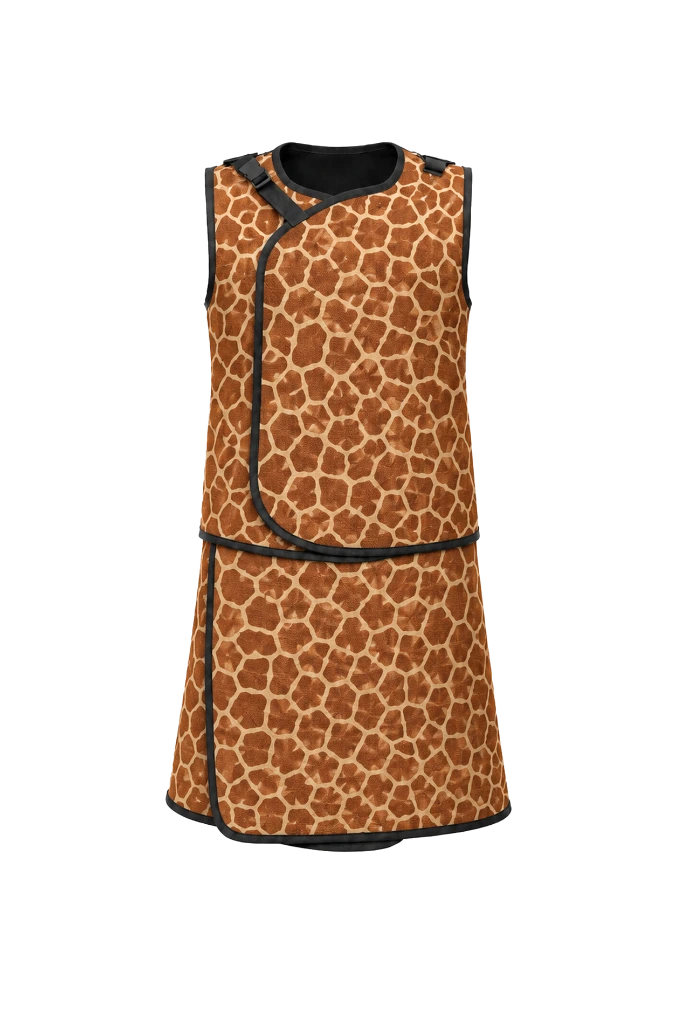
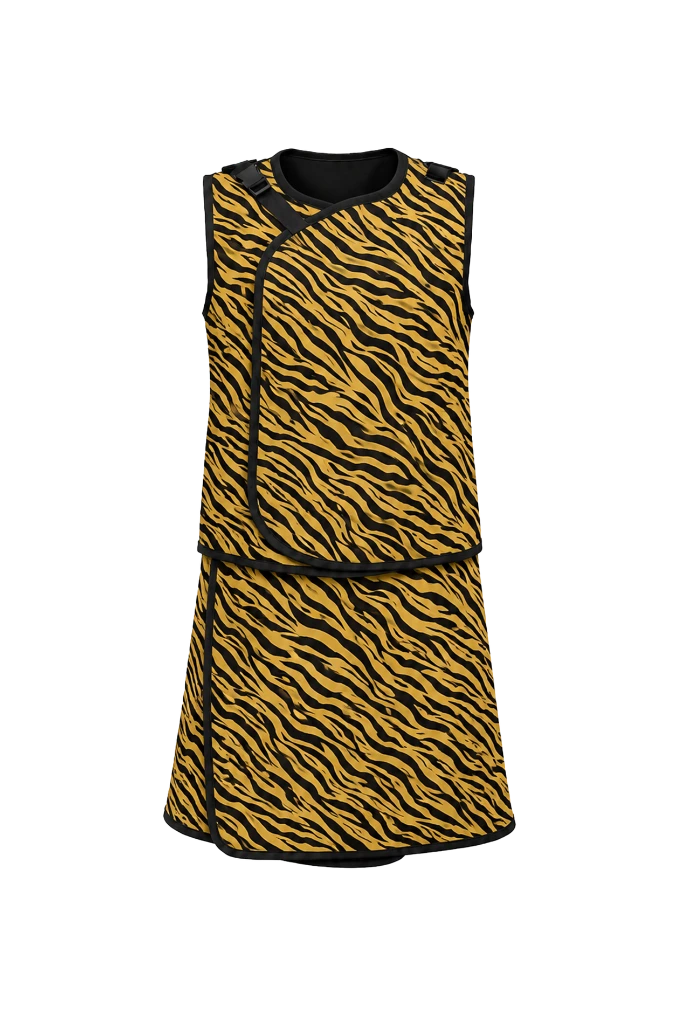
Aprons from Rothband’s Safari collection. Photograph: Rothband.
Walk into any department store of radiation protection jargon and the first wall you hit is "Pb equivalence". It is actually simple: it is the thickness of lead that would attenuate X-rays to the same degree as the garment in front of you, under standardised test conditions. A 0.35mm Pb-equivalent apron behaves, in attenuation terms, like a 0.35mm sheet of lead — whether or not it contains any lead at all.
So what do the numbers mean in practice?
| Equivalence | Where it is typically used |
|---|
| 0.25mm Pb | Most general diagnostic radiology, where scatter is modest and technique and distance do a lot of the work |
| 0.35mm Pb | Interventional radiology, fluoroscopy-heavy lists, cardiology labs — where scatter doses are highest |
| 0.50mm Pb | Legacy heavy aprons; still seen, but worth questioning whether the extra weight earns its place |
The question to ask about 0.5
More is not automatically safer. Protection that is too heavy to wear properly for a whole list — aprons loosened, collars dropped, staff rotating out — can leave people worse off than a lighter garment worn correctly for every case. Several clinicians have made the case that 0.35mm is the sensible ceiling for most interventional work, with 0.5mm reserved for specific higher-exposure situations. The right call belongs to your RPA, informed by your local dose assessments.
What to check beyond the number
- Certification. The equivalence claim should be certified to BS-EN 61331-1:2014. If the number is not stated and not certified, do not assume it.
- Front and back. Many wraparound aprons quote the front-panel equivalence where panels overlap; know what the back and single-layer areas give you.
- The collar too. The thyroid collar is part of the same calculation — a 0.35 apron with an ungraded collar has a gap in the chain.
- Wearability. The best-specified apron in the catalogue is not the best apron on the day if nobody wants to keep it on. Two-piece styles, support belts and lightweight cores exist precisely to close that gap.
General guidance — your RPA confirms the appropriate level for your department. Rothband aprons are available in standard equivalences, all certified to BS-EN 61331-1:2014.
“The best apron is the one still being worn correctly at the end of the list.”
Filed under: Pb Equivalence, Buying, Explainer
Campaigns • New
Protect the thyroid: the collar is not an accessory
One of the most radiosensitive organs in the body, sitting unprotected in the scatter field. Fit it, grade it, inspect it.
RTBy the Rothband Team15 October 20264 min read

Thyroid collars. Photograph: Rothband.
The thyroid sits unprotected in the scatter field during every fluoroscopy and interventional case — and it is one of the most radiosensitive organs in the body. Yet the collar remains the item most likely to be skipped, shared badly, or worn loose. Rothband has campaigned on this before, and the message has not gone stale: the collar is not an accessory. It is part of the protection.
Fit is the protection
A thyroid collar only works where it sits. It should fit snugly around the neck, covering the thyroid, with no gap between the collar and the apron's neckline. Shared collars that fit nobody, collars worn loose like scarves, and collars left on the rail "for short cases" all create the same problem: an unprotected gland in a scatter field.
Treat collars like aprons
- Give it an equivalence. Know its certified Pb equivalence — it should match the job it is doing.
- Inspect it on the same schedule. Collars are crushed between garments on crowded rails. Run them through the same visual, tactile and periodic imaging checks as aprons.
- Make it personal where you can. Individually issued collars beat shared ones for fit, hygiene and the simple fact of actually being worn.
- Mind the gap. Check that collar and apron overlap properly in the positions your staff actually work in — leaning, turning, reaching — not just standing to attention.
The bottom line
Departments audit aprons and forget collars. Put the collar on the inspection log, in the fitting programme and on the ordering checklist — and protect the thyroid every case, not just the long ones.
General guidance — confirm arrangements with your RPA. Rothband supplies thyroid collars in certified equivalences and can advise on sizing and fitting for teams.
“The collar is not an accessory. It is part of the protection.”
Filed under: Thyroid, PPE, Campaigns
Occupational Health • New
The weight of protection: why lighter aprons are a safety feature
Backs, necks and shoulders are radiation protection’s quiet casualty list. Weight is a safety spec — buy it like one.
RTBy the Rothband Team15 October 20265 min read
Worn all day, every list: weight matters. Photograph: Rothband.
Ask interventional staff what hurts at the end of a list and the answer is rarely the radiation — it is the back, the neck and the shoulders. Surveys of catheter-lab and interventional teams consistently show high levels of musculoskeletal complaints among people who wear leaded PPE for hours a day. The weight of protection is an occupational-health problem in its own right.
Why weight is a protection problem
A heavy one-piece apron concentrates load on the shoulders and lower back for the entire case. Staff compensate by leaning, by loosening closures, or by rotating off lists — and every one of those adaptations changes exposure geometry or reduces wearing time. A lighter garment, worn correctly for every case, protects better than a heavier one worn half-heartedly. Compliance is dosimetry.
What actually reduces the load
- Two-piece systems. Skirt-and-vest designs split the weight between shoulders and hips, which most wearers find far more sustainable over long lists.
- Lightweight cores. Lead-free and composite materials — including Rothband's Bilayer technology — achieve the same certified Pb equivalence at significantly lower weight than traditional lead.
- Proper fit and support. Belts and support systems that distribute load only work on correctly sized garments. Fit clinics for teams are cheap compared with one staff injury.
- Culture. Making weight and comfort a procurement criterion — alongside equivalence and price — is how departments stop buying the heaviest apron that passes the paperwork.
The bottom line
Buying on attenuation alone buys you a protection figure and a physiotherapy bill. Specify weight, fit and wearing comfort as safety features — because in practice, that is exactly what they are.
General guidance only. Rothband's lightweight and Bilayer aprons are designed around this problem — talk to the team about team fittings and weight comparisons.
“Compliance is dosimetry: a lighter apron worn all case protects better than a heavier one taken off early.”
Filed under: Musculoskeletal Health, Occupational Health
From the Wires
Shared stories • summarised by Rothband, published by others
We read the regulators, colleges and journals so your department doesn’t have to. Every story below is summarised in our words, with our take — and a link to the original publication, which owns it.
Shared • Standards • September 2026
The updated quality framework UK imaging services are assessed against — including how significant accidental or unintended exposures are handled.
Our take: If your quality manual still cites the old version, update it now, not the week before assessment.
Originally published by Royal College of Radiologists / College of Radiographers • September 2026 • Read the original →
Shared • NHS • September 2026
AXREM and the IHPN’s joint paper on how manufacturers and independent providers are helping the NHS expand diagnostic capacity.
Our take: New sites remember scanners long before apron rails and QC schedules. Protection belongs on the commissioning checklist.
Originally published by AXREM / IHPN, via Convenzis • September 2026 • Read the original →

Shared • Global Health • October 2026
The agency is helping countries build investment cases to expand and decentralise radiotherapy and diagnostic services.
Our take: Every capacity argument is a protection argument — throughput only grows safely when PPE and dose monitoring grow with it.
Originally published by IAEA News Centre • October 2026 • Read the original →
Shared • Global • 28 September 2026
Regional representatives reviewed a year of IAEA technical cooperation, with human health and radiation safety among the priorities.
Our take: Safety improves fastest where standards and training are shared — the model UK departments use informally every day.
Originally published by IAEA News Centre • 28 September 2026 • Read the original →
Shared • Events • Vienna, October 2026
Standards, applications and quality assurance in medical radiation dosimetry — the field’s benchmark-setting meeting.
Our take: Standards agreed in rooms like this become the calibration behind your department’s dose figures.
Originally published by IAEA Events • October 2026 • Read the original →
Shared • Regulator • Guidance, current edition
The CQC’s IRMER pages include updated investigation and notification expectations for significant accidental or unintended exposures, with amended criteria for interventional radiology and cardiology.
Our take: SAUE paperwork is where IRMER stops being theory. Check your route against the current criteria before you need it.
Originally published by Care Quality Commission • Guidance — current edition • Read the original →

Shared • Enforcement • 10 February 2026
New South Wales regulators prosecuted a mobile imaging company and radiographer over thousands of X-rays performed without a radiation licence, with heavy fines imposed.
Our take: A cautionary tale from the other side of the world: entitlement paperwork is not bureaucracy. It is the job.
Originally published by NSW EPA, via Medianet News Hub • 10 February 2026 • Read the original →
Shared • Technology • 7 October 2026
A Japanese-developed monitor that identifies radioactive materials in the air in real time has taken one of the industry’s major innovation awards.
Our take: Faster identification of airborne contamination is the kind of quiet jump that reaches hospital physics departments within years.
Originally published by Business Wire • 7 October 2026 • Read the original →
Shared • Safety • Industry guidance
Guidance for recyclers and producers on finding and handling stray radioactive material in scrap streams.
Our take: Orphan sources are a real protection problem beyond hospitals — radiation safety is an industry, not a department.
Originally published by Recycling Today • Industry guidance • Read the original →
Shared • Regulator • The reference text
HSE’s anchor guidance for IRR17 — graded authorisation, public dose estimates, and the eye-lens limit cut from 150 to 20 mSv.
Our take: If your local rules predate 2018, they predate the current regime. L121 is the document to re-read first.
Originally published by Health and Safety Executive • The reference text • Read the original →
The Wire • Monthly Roundup
The Wire: this month’s roundup in full
What happened, why it matters, and what we think — the October edition.
RTCompiled by the Rothband Editorial Team15 October 20264 min read
Welcome to The Wire — Rothband’s monthly roundup of what is moving in radiation protection and UK imaging. We read the regulators, the colleges, the trade bodies and the journals, summarise each story in our own words, and link you to the original. Here is this edition.
1. A new Quality Standard for Imaging — QSI 2026
What happened: The Royal College of Radiologists and the College of Radiographers have published the Quality Standard for Imaging 2026, the updated framework UK imaging services use to evidence quality, safety and governance — including how significant accidental or unintended exposures (SAUEs) are handled.
Why it matters: QSI is the yardstick many services are assessed against. If your department’s quality manual still references the previous version, this is the moment to review policies, audit calendars and your SAUE reporting route.
Our take: Standards updates are where good departments quietly get ahead. Map the changes once, share the summary with the whole team, and file the evidence as you go — not the week before an assessment.
Source: Royal College of Radiologists / College of Radiographers, Quality Standard for Imaging 2026 — via the Society of Radiographers.
2. Community Diagnostic Centres: partnerships under the spotlight
What happened: AXREM, the trade association for imaging suppliers, and the Independent Healthcare Providers Network have published a joint discussion paper on the role of equipment manufacturers and independent providers in expanding Community Diagnostic Centres (CDCs) across the UK.
Why it matters: CDCs are a central part of the NHS plan to cut diagnostic waiting times and bring scanning closer to patients. New sites mean new rooms, new teams — and new radiation protection arrangements, from shielding and local rules to PPE fleets, all stood up at speed.
Our take: Expansion programmes remember scanners and staffing long before they remember apron rails, eyewear fitting and QC schedules. If your organisation is opening or supplying a CDC, put protective equipment and its inspection regime on the commissioning checklist from day one, not as an afterthought.
Source: Clinical Services Journal, “AXREM and IHPN publish paper on the role of partnerships in expanding community diagnostic services.”
3. IAEA: investment push to widen access to radiotherapy
What happened: The International Atomic Energy Agency reports it is helping countries build investment cases to expand and decentralise radiotherapy and diagnostic services, including support for a major expansion programme in Mongolia and first services in countries where patients currently must travel abroad for treatment.
Why it matters: Globally, the gap is not knowledge — it is capacity. The IAEA work underlines that new treatment capacity only delivers safely when trained staff, safety standards and protection programmes grow with the equipment.
Our take: A useful reminder for UK departments too: every capacity argument is also a protection argument. More lists, more throughput and more complex cases all increase the premium on well-fitted PPE, maintained screens and honest dose monitoring.
Source: IAEA News Centre, “IAEA Helps Countries Mobilize Investment to Expand Radiotherapy Services.”
In one line
Standards are tightening, diagnostic capacity is expanding, and the departments that cope best will be the ones whose radiation protection keeps pace with their growth — not the ones catching up after an inspection.
The Wire summarises third-party reporting for professional readers. Always read the linked original for the full detail, and confirm any regulatory point with your RPA or MPE before acting on it.
Filed under: The Wire, News