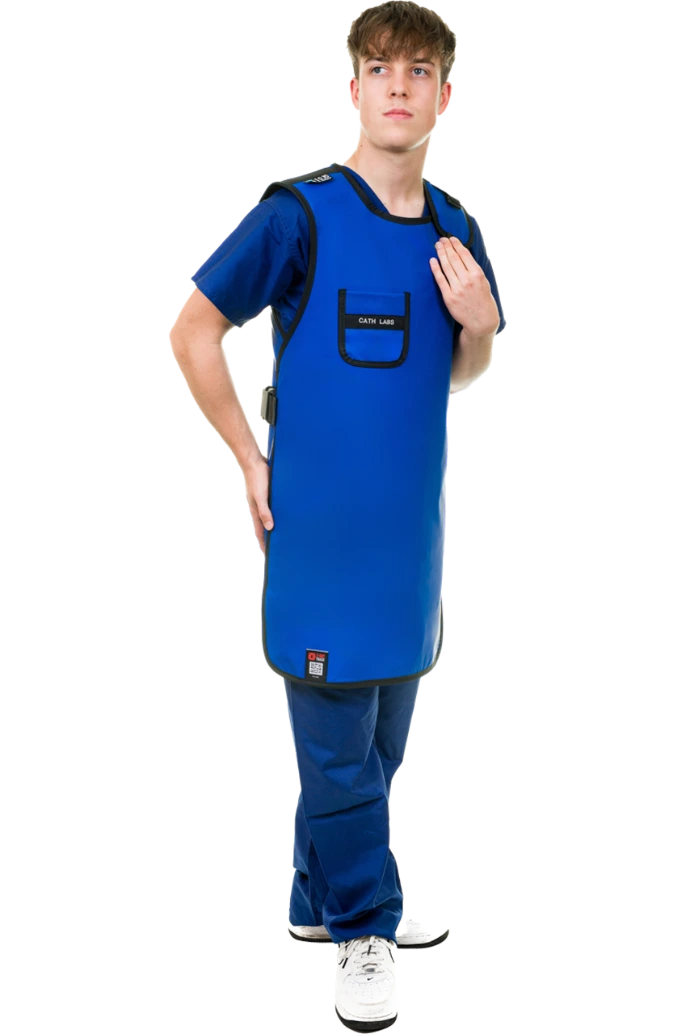

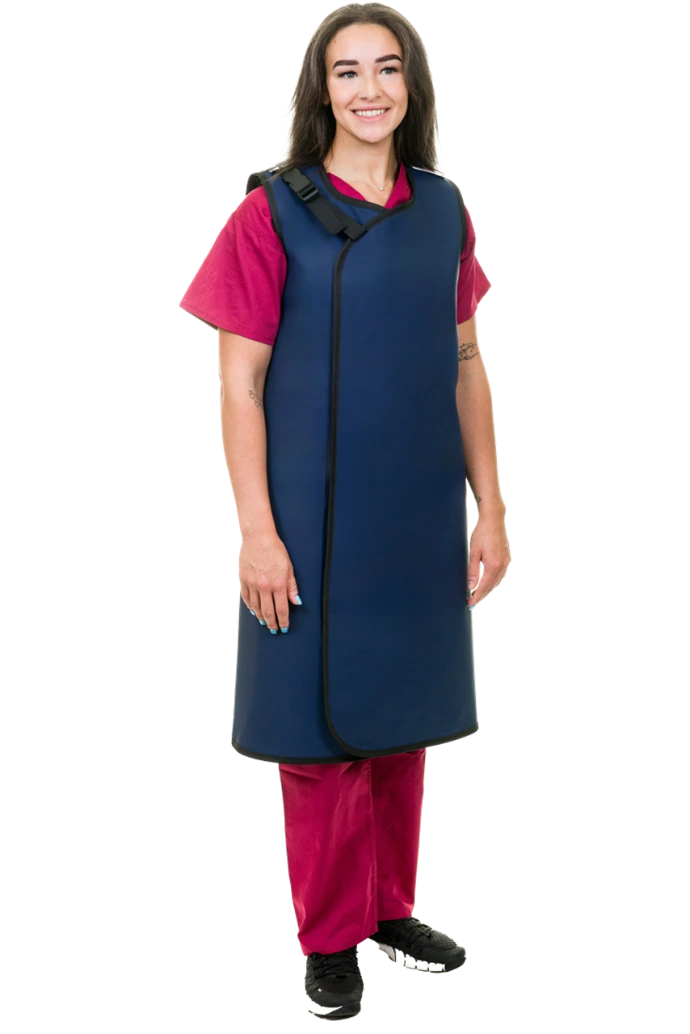
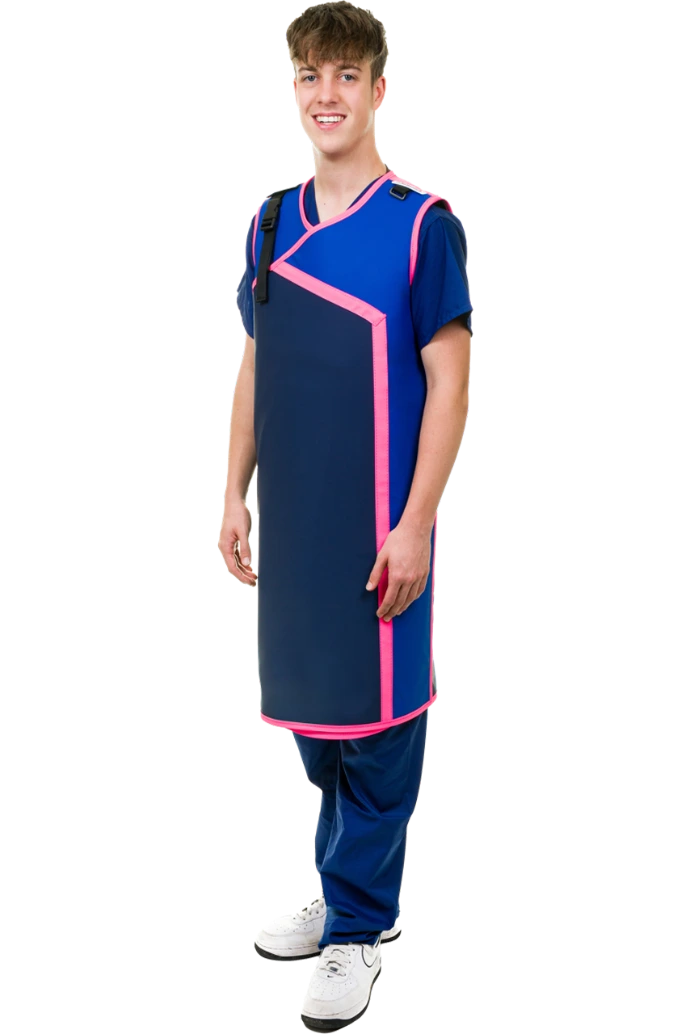
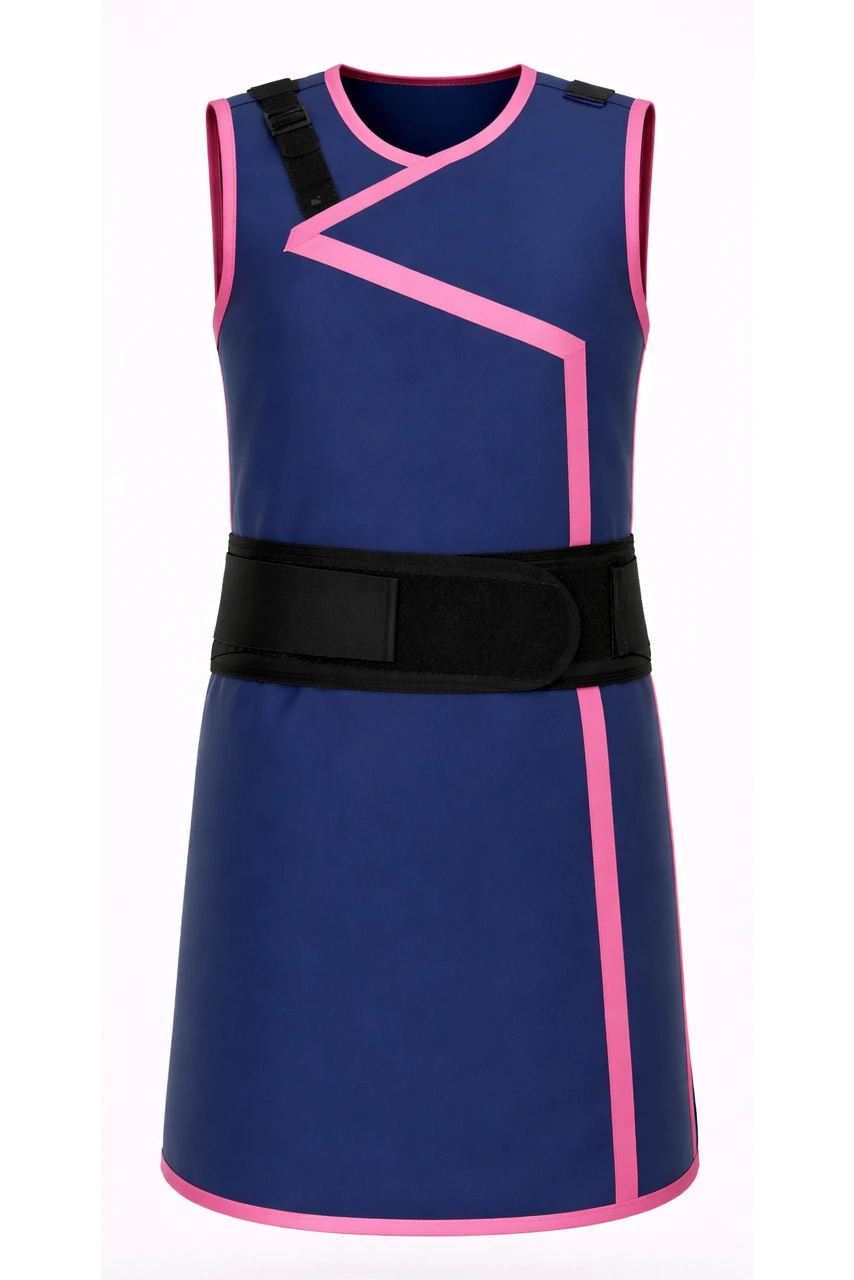
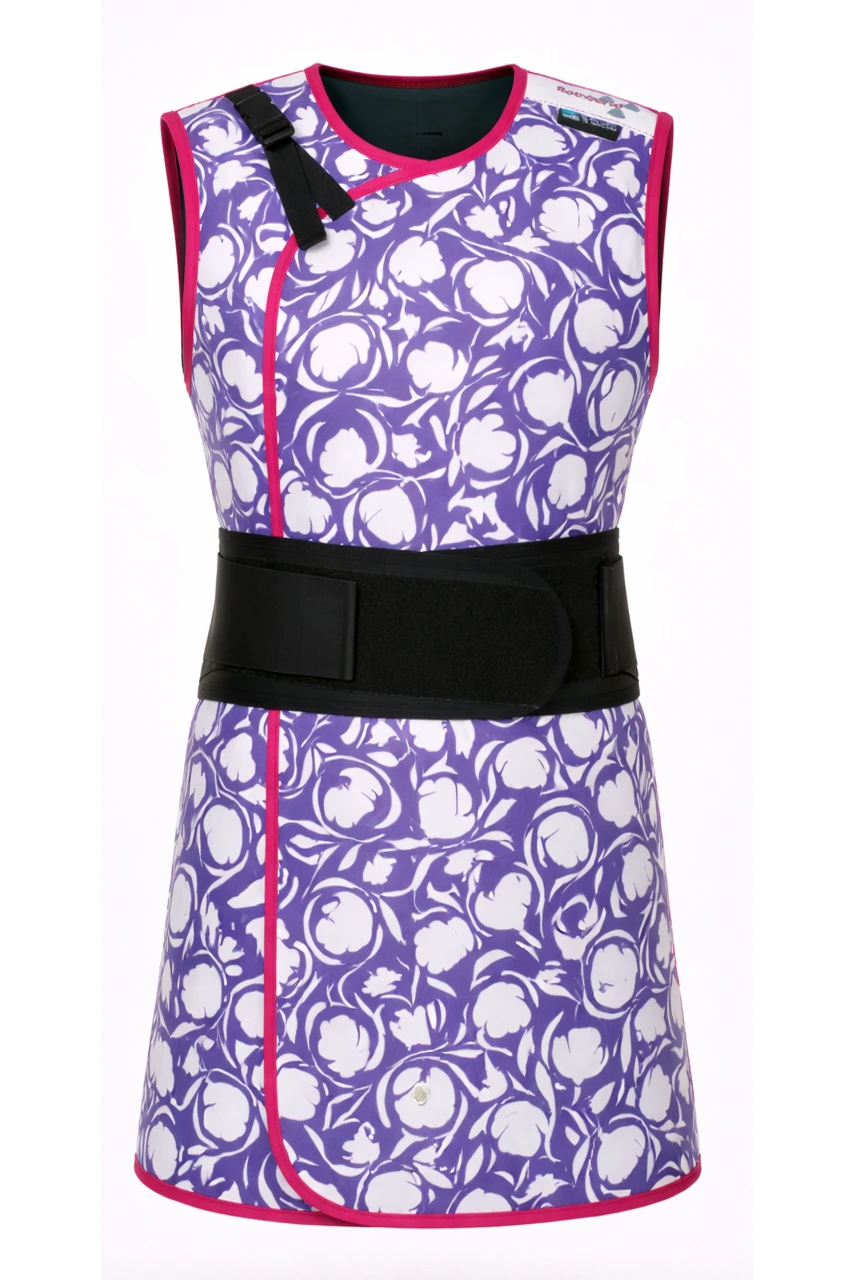

What is a lead apron?
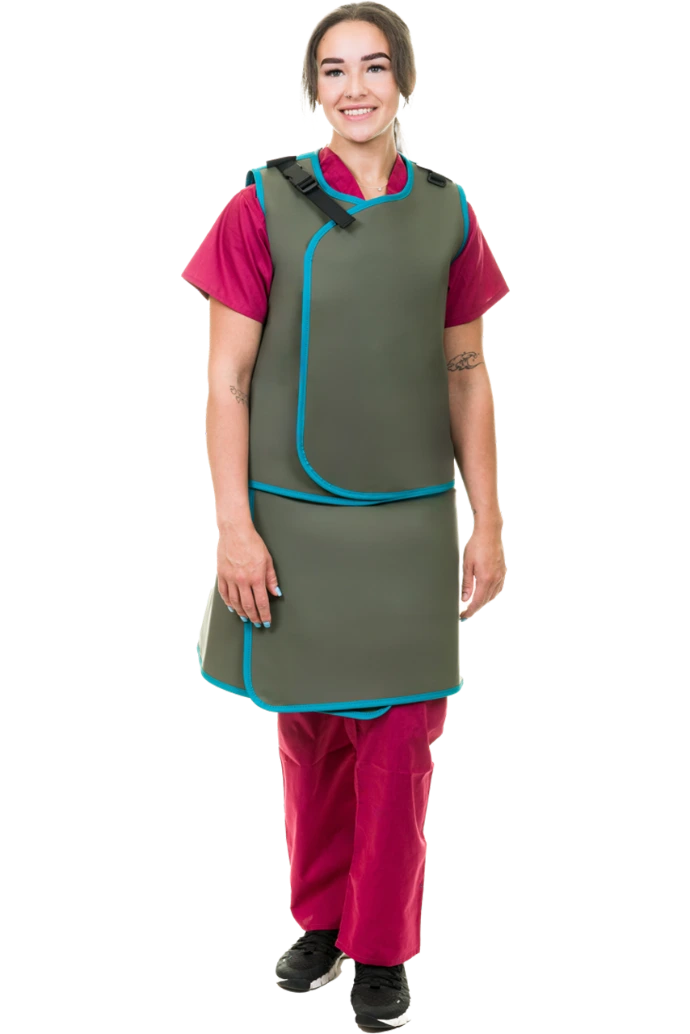
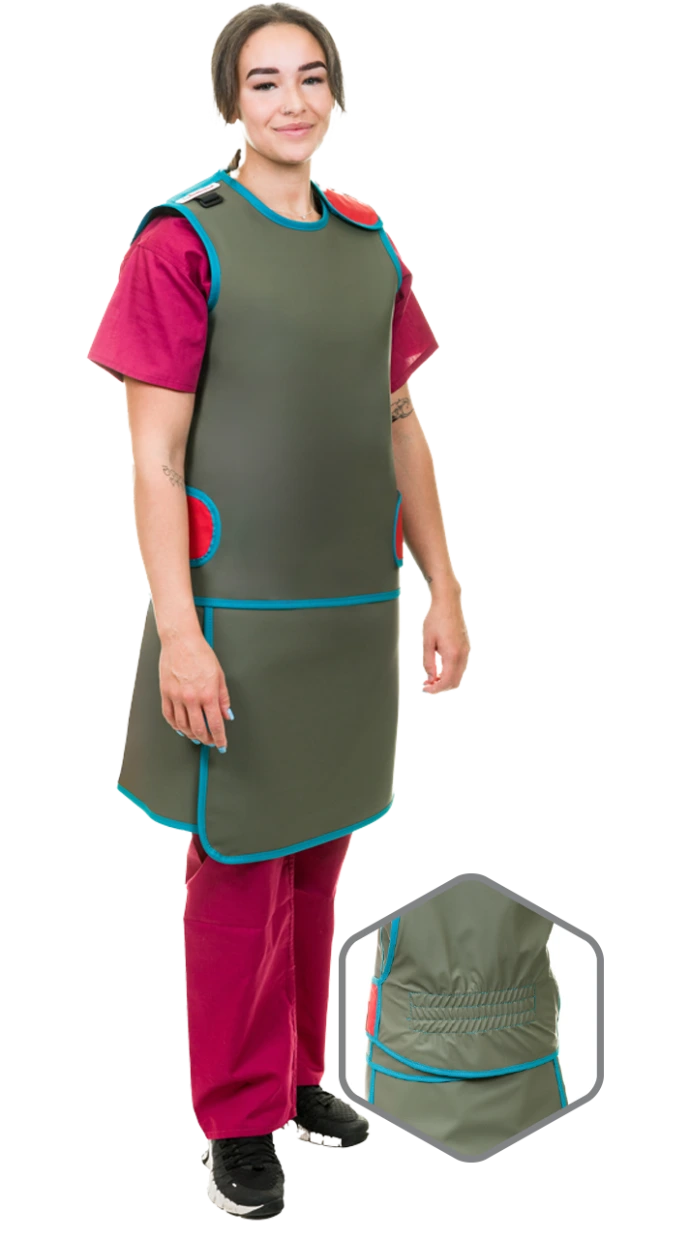
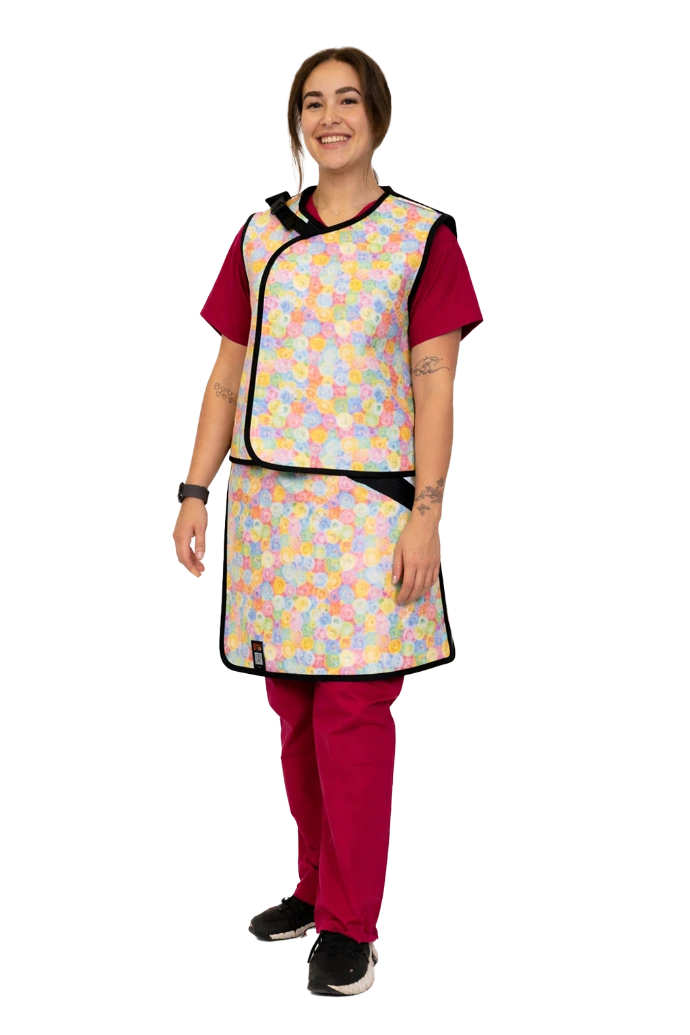
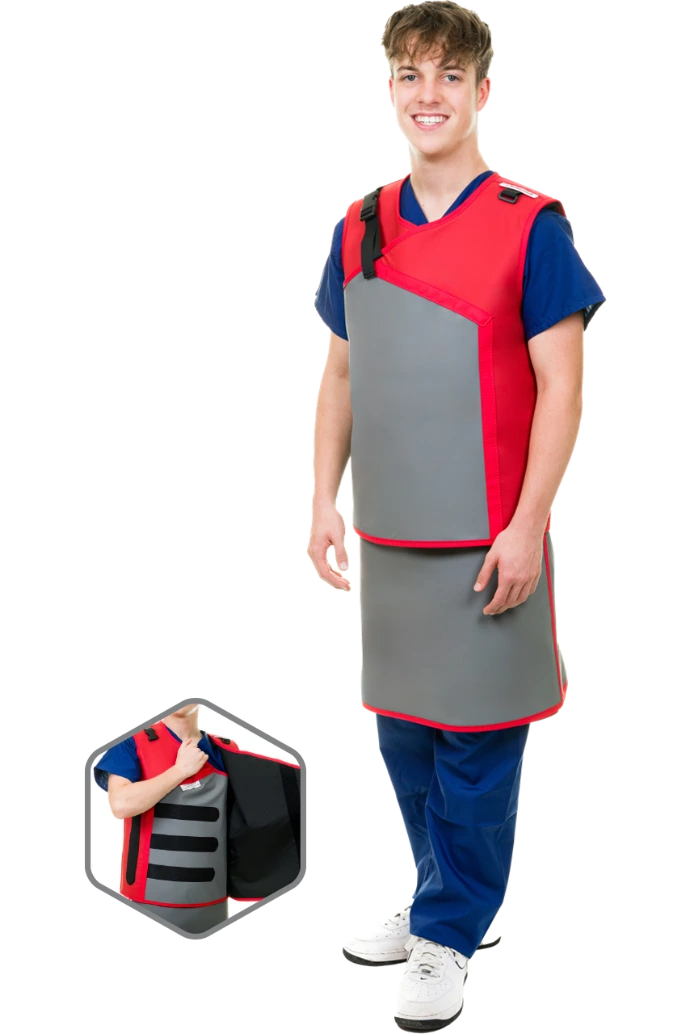
A lead apron is a special safety coat that helps block scatter radiation when X-rays are being used. It helps protect people working near the X-ray, but it is only one part of staying safe.
Do lead aprons stop all radiation?
No. A lead apron does not stop everything. It helps reduce a lot of the scatter radiation, but people still need good room shielding, safe working rules, and the right way of standing. Lead aprons are designed to reduce scatter dose, not create total shielding. IEC 61331-3 specifically treats them as protective devices used where other methods are insufficient or not applicable, and IAEA guidance similarly presents them as one part of a wider occupational radiation protection approach. Generally Radiation PPE designed for healthcare is designed to protect against X-Rays, which have different charateristics than other types of ionising radiation.
How much radiation does a lead apron block?
A lead apron can cut a big amount of scatter radiation. The IAEA says aprons may reduce dose by more than 90%, but the exact amount depends on the X-ray energy and the apron’s lead-equivalent rating. The amount depends on beam quality and the apron’s labelled lead equivalence. Most IEC approved lead aprons will reduce dose by over 90%, , depending on kV and lead-equivalent thickness; your manufacturer should be able to provide you with information about their core materials and its test results. The test standard for lead aprons in Europe is one call IEC 61331-1:2014 BBG* and your manufacturer should have this as part of their techical files.
What do 0.25 mm, 0.35 mm and 0.50 mm Pb mean?
The bigger the lead equivalence number, the less radiation gets through the apron. So a 0.25 mm Pb apron blocks a lot, a 0.35 mm Pb apron blocks more, and a 0.50 mm Pb apron blocks the most of the three. The Edge Bilayer presentation gives an example at 80 kV where 0.25 mm LE attenuates about 90% and 0.50 mm LE attenuates about 98%.
A higher lead equivalence means less radiation passes through the apron. In simple terms, a 0.25 mm Pb apron blocks a lot of scatter radiation, a 0.35 mm Pb apron blocks more, and a 0.50 mm Pb apron blocks the most of the three.
It is important not to think about this as just a small percentage difference. What really matters is the amount of radiation that still gets through the material. For example, if one apron lets 10% through and another lets 2% through, the wearer of the first apron may receive far more radiation in the same environment. That is why moving from 0.25 mm Pb to 0.50 mm Pb can make a significant difference in higher-scatter environments, even if the attenuation percentages can look close at first glance.
In practical terms:
- 0.25 mm Pb is a lighter-duty option and can be suitable where exposure levels are lower.
- 0.35 mm Pb gives a useful step up in protection and is commonly chosen where stronger front protection is needed.
- 0.50 mm Pb provides the greatest attenuation of the three, but usually with a weight penalty.
Is 0.25 mm Pb enough?
Sometimes yes, sometimes no. It can be suitable in some lower-scatter jobs, but busier interventional or higher-dose work may need more protection or a different style. The safe choice depends on your room, your job, and your risk assessment.
What is the best core material: lead or lead-free?
There is no one “best” for everybody. Traditional lead can be a good choice for higher-kV work, while some lead-free or bilayer materials can be lighter and better for long wear. The smart thing is to check the certified lead equivalence and the kV range the material was tested to.
Which lead equivalence do I need?
That depends on where you work and what kind of X-rays you are around. BIR says the right lead equivalence and PPE type should come from a radiation risk assessment with help from a Radiation Protection Adviser.
What is absorbed dose?
Absorbed dose is the amount of radiation energy deposited in a material, such as tissue, water or air. It tells you how much radiation energy has actually gone into the body or object being exposed. In simple terms, sunburn is absorbed dose, the more you can see how the body is absorbing it and the effect on your skin. Radiation dose is cumulative.
What is effective dose?
Effective dose is a calculated value used to estimate the overall biological risk from radiation exposure. It starts with absorbed dose, but then also takes into account:
- the type of radiation involved, and
- which tissues or organs were exposed, because some parts of the body are more sensitive than others.
A simple way to think about it is: effective dose is what that radiation dose may mean for long-term risk to the person.
What is the best core material: lead or lead-free?
There is no one “best” for everybody. Traditional lead can be a good choice for higher-kV work, while some lead-free or bilayer materials can be lighter and better for long wear. The smart thing is to check the certified lead equivalence and the kV range the material was tested to.
As radiation protection materials evolved beyond traditional lead, test methods also had to evolve. Earlier test approaches were primarily developed around the predictable attenuation properties of lead itself. However, modern lead-free and composite shielding materials behave differently when exposed to X-ray energies used in medical imaging. Their performance can vary significantly depending on beam quality, filtration, and energy range. For that reason, recognised standards such as IEC 61331 introduced more robust and representative test methods to ensure that newer materials are assessed fairly, consistently, and under conditions relevant to real clinical use. This change was essential to protect users from misleading claims based on outdated or simplified testing methods.
It is true that some lead-free aprons on the market can be made exceptionally light in weight. However, lower weight alone should never be mistaken for better protection. In some cases, materials designed primarily to reduce mass may struggle to achieve the required attenuation performance across the full range of diagnostic X-ray energies when tested to appropriate modern standards. A garment should therefore be selected on verified protection performance, comfort, durability, and compliance, not simply on how light it feels.
In recent years, the cost of many lead-free raw materials has risen sharply. This is largely due to global demand, specialist metal supply chains, and the increased cost of processing complex composite shielding blends. As a result, fully lead-free solutions can sometimes carry a significant price premium.
To address both performance and affordability, modern bilayer shielding materials have become an important innovation. By combining optimised layers of complementary shielding compounds, including the controlled use of lead where appropriate , it is possible to improve attenuation efficiency through better radiation physics, while keeping garment weight practical and costs more manageable. This balanced approach allows healthcare providers to access lightweight, compliant, and commercially sensible protection solutions without compromising safety.
Why are some lead aprons heavier than others?
Because weight changes with the size, length, style, core material, and protection level. More coverage and more shielding often mean more weight. Rothband’s core material guide also shows different area weights for different materials and Pb levels
What is the lightest lead apron?
Usually, lighter aprons use a lighter core material, a smarter design, or less extra material. But the lightest apron is not always the best apron. It still has to fit well and be tested for the environment you work in.
When it comes to Bilayers and Lead Free materials, in order to pass the test requirements and from a metal content point of view, all the materials, from all manufacturers are all pretty much the same. Most differences in weight are dependent on the matrix encapsulating the metals. This has varying results in weight, and how effective it is at holding onto to those protective elements. So there needs to be a balance.
Which apron style is right for me?
That depends on how you work. Some people want a simple front apron. Some need wraparound protection. Some like a top-and-kilt set because it can help spread weight. Online discussions also show that people often choose style based on comfort, back coverage, and how much turning they do during cases.
How are lead aprons tested?
The core material is tested using the IEC 61331-1 standard. For protective aprons and thyroid collars, IEC 61331-3 says the lead equivalent is determined using the inverse broad beam method for set radiation qualities. For normal apron use, the standard test points are 50, 70, 90 and 110 kV. The tests are performed at specialised test centres across the globe.
What if I work in a CT room or another high-kV environment?
Then you should be extra careful about what the material was tested to. BIR says PPE used above 125 kVp should meet or exceed the lead-equivalent values for 150 kVp, and Rothband also notes that some materials are tested only to 110 kV while others are tested to 150 kV.
How often should a lead apron be checked?
The ionising Radiation Regulations (2017) recommends aprons are inspected regularly, other groups suggest this should be at least once a year. Regular quick checks are smart too, so you can spot cracks, lumps, holes, sagging, or broken fasteners early.
Should a brand new apron be checked when it arrives?
Yes. Newly bought aprons should be radiographically checked before use to make sure there is no hidden damage from manufacturing or transport.
How do I store a lead apron properly?
Hang it up nicely on a proper apron hanger or rack. Do not fold it, squash it, drape it over sharp hooks, or sit on it. Bad storage can help cause cracks inside the apron.
When should a lead apron be repaired or replaced?
What is the best lead apron for a bad back?
Is a two-piece apron better than a one-piece apron?
Sometimes yes. Many people like two-piece aprons because the weight can feel easier to carry.
Two-piece systems are often preferred by users who wear PPE for long procedures because they can distribute weight between shoulders and hips and allow separate sizing of the top and skirt. That said, “better” depends on coverage needs, overlap design, and how the wearer actually works during the case. User forums strongly favour two-piece systems for comfort, but the final choice should still be made on protection plus fit, not comfort alone.
How should a lead apron fit?
It should cover what needs protecting and should not leave big gaps.
IEC 61331-3 says operator aprons should cover the body from the throat to at least the knees, including the breastbone and shoulders. Sizing should allow proper correlation to body dimensions, and supplier guidance should be used to avoid poor fit around key areas. Correct fit matters for both protection and comfort.
Particular attention should be paid to the armholes and the areas around the breast tissue.
Do patients still need lead aprons for X-rays?
In most cases, no — and this is a deliberate change, not a cost-saving one. UK guidance from the British Institute of Radiology (2020) and, internationally, bodies such as the American Dental Association (2024) no longer recommend routine lead shielding of patients, because modern equipment and tight beam collimation keep patient doses very low, and shields can obscure anatomy or interfere with automatic exposure control — sometimes causing repeat X-rays. Patient shielding is still used in specific situations identified by local risk assessment and policy.
The people who do still wear protection are staff and carers: anyone who remains in the room during exposures — radiographers, interventional teams, or a parent holding a child — is exposed to scatter radiation repeatedly, with no diagnostic benefit, and should wear appropriate protective garments. See staff protection and patient protection at rothband.com.
What is scatter radiation?
Scatter radiation is X-ray energy that deflects off the patient (or other objects in the beam) and travels in other directions around the room. The patient receives the primary beam; everyone else in the room is exposed to scatter. Scatter is why staff wear lead aprons, thyroid collars and lead glasses, and why rooms use mobile barriers and screens and structural shielding — protection is aimed at the scattered dose, not the primary beam.
What are the UK radiation dose limits for workers?
Under the Ionising Radiations Regulations 2017 (IRR17), the annual limit for employees aged 18 or over is 20 mSv effective dose. The limit for the lens of the eye is also 20 mSv per year — reduced from 150 mSv under the previous regulations — and the limit for the skin and extremities is 500 mSv. Employers must keep exposures as low as reasonably practicable below these limits, which is why PPE, shielding and monitoring all matter even when doses are already legal. Rothband supplies Instadose personal dosimetry for monitoring.
What does ALARP (or ALARA) mean?
ALARP stands for As Low As Reasonably Practicable (ALARA — As Low As Reasonably Achievable — is the equivalent international term). It is the core principle of radiation protection: doses should not merely be under the legal limit, but reduced as far as is reasonably practicable using time, distance, shielding and good technique. In practice that means minimising screening time, standing back where possible, using barriers and wearing correctly specified protective garments.
How much does standing further away reduce radiation dose?
A great deal — scatter dose follows the inverse square law, so doubling your distance from the source cuts the dose to roughly a quarter; tripling it cuts the dose to about a ninth. Distance is one of the cheapest and most effective protection measures available, which is why it sits alongside time and shielding as one of the three pillars of radiation protection.
Why do radiologists and cath lab staff wear lead glasses?
Because the lens of the eye is one of the most radiosensitive tissues in the body, and chronic exposure to scatter is associated with radiation-induced cataract. That evidence is why IRR17 cut the annual eye lens dose limit from 150 mSv to 20 mSv. Staff who work close to the patient during fluoroscopy and interventional procedures — cardiologists, radiologists, scrub staff — are the priority wearers. See X-ray protective glasses at rothband.com.
Do thyroid collars actually work — and who should wear one?
Yes. The thyroid gland is radiosensitive and sits exposed at the neckline of most aprons, and a certified thyroid collar attenuates scatter to it in the same way an apron protects the trunk. Collars are most valuable for staff who work close to the patient during fluoroscopic and interventional procedures, and are commonly specified alongside an apron in cath labs and theatres. See thyroid collars at rothband.com.
Is it safe to have an X-ray while pregnant?
Diagnostic X-rays that don't involve the abdomen or pelvis deliver a negligible dose to the fetus, and even most abdominal examinations involve doses far below the level associated with harm. The decision is always a clinical one: tell your radiographer or referrer if you are or might be pregnant, and they will apply justification and dose-optimisation procedures — the examination will only proceed when the benefit outweighs the very small risk.
Can I keep working with radiation while pregnant?
Usually yes. Under IRR17, once an employee declares a pregnancy in writing, the employer must ensure the dose to the fetus does not exceed 1 mSv for the remainder of the pregnancy — a level most diagnostic imaging roles achieve comfortably with normal precautions. Employers review the risk assessment, and working practices or PPE may be adjusted; correctly fitted protective garments matter here, which is why proper sizing is worth getting right.
Who needs to wear lead when X-raying animals?
Anyone who stays in the room during a veterinary exposure — and especially anyone manually restraining an animal — should wear a protective apron and, where hands may approach the primary beam, protective gloves should be considered alongside good technique. Holding should be minimised through sedation, positioning aids and sandbags wherever practicable, so that people can step away entirely. Rothband supplies protective garments and positioning aids to veterinary practices across the UK.
What is a Radiation Protection Adviser (RPA)?
An RPA is a certified expert that UK employers working with ionising radiation must consult under IRR17 — on matters such as risk assessments, room shielding design, dose monitoring, PPE specification and contingency plans. Day to day, a Radiation Protection Supervisor (RPS) within the department helps ensure local rules are followed. Questions like "which lead equivalence do I need?" should ultimately be settled through a risk assessment with your RPA — and Rothband can support that conversation with certified attenuation data for every garment.
How do I know if my lead apron still works?
Age alone doesn't fail an apron — condition does. An apron remains protective while its shielding core is intact, which is why IRR17 expects regular inspection: quick visual and tactile checks for cracks, lumps, sagging or damaged fasteners, plus periodic radiographic or fluoroscopic screening (professional guidance suggests at least annually, and on arrival for new aprons). If screening reveals defects over critical areas, repair or replace. Rothband offers an apron scanning service, X-Ray Track management software for tracking your fleet, and a free apron care guide.
A note on these answers: they are general guidance on radiation protection principles, written by Rothband (WSR Medical Solutions Ltd), a UK radiation protection manufacturer since 1911. They are not a substitute for your local rules, risk assessment or the advice of your Radiation Protection Adviser. For product specifications, certified attenuation data or sizing, visit www.rothband.com or contact sales@rothband.com.